
Tianya Zhou
Biography
Tianya Zhou was born in Jingzhou City, Hubei Province, China, in 1973. He studied Art Education at the Hubei Institute of Fine Arts from 1992 to 1994 and later obtained a bachelor’s degree in Art and Art Education there, specialising in watercolour and oil painting. He has taught painting at Shayang Teacher School, Jingchu Academy of Technology and Donghu Middle School. Since 2012 he has worked as a full-time curator and professional artist at the Visual Arts Department of Luohu Cultural Center in Shenzhen, where he founded the Shenzhen International Watercolor Biennial Exhibition and served as curator and organiser from 2013 to 2017. He is a member of the American Watercolor Society, National Watercolor Society, Canadian Society of Painters in Water Colour and China Artists Association, and an Honorary Member of the Australian Watercolour Institute.
Artist Statement
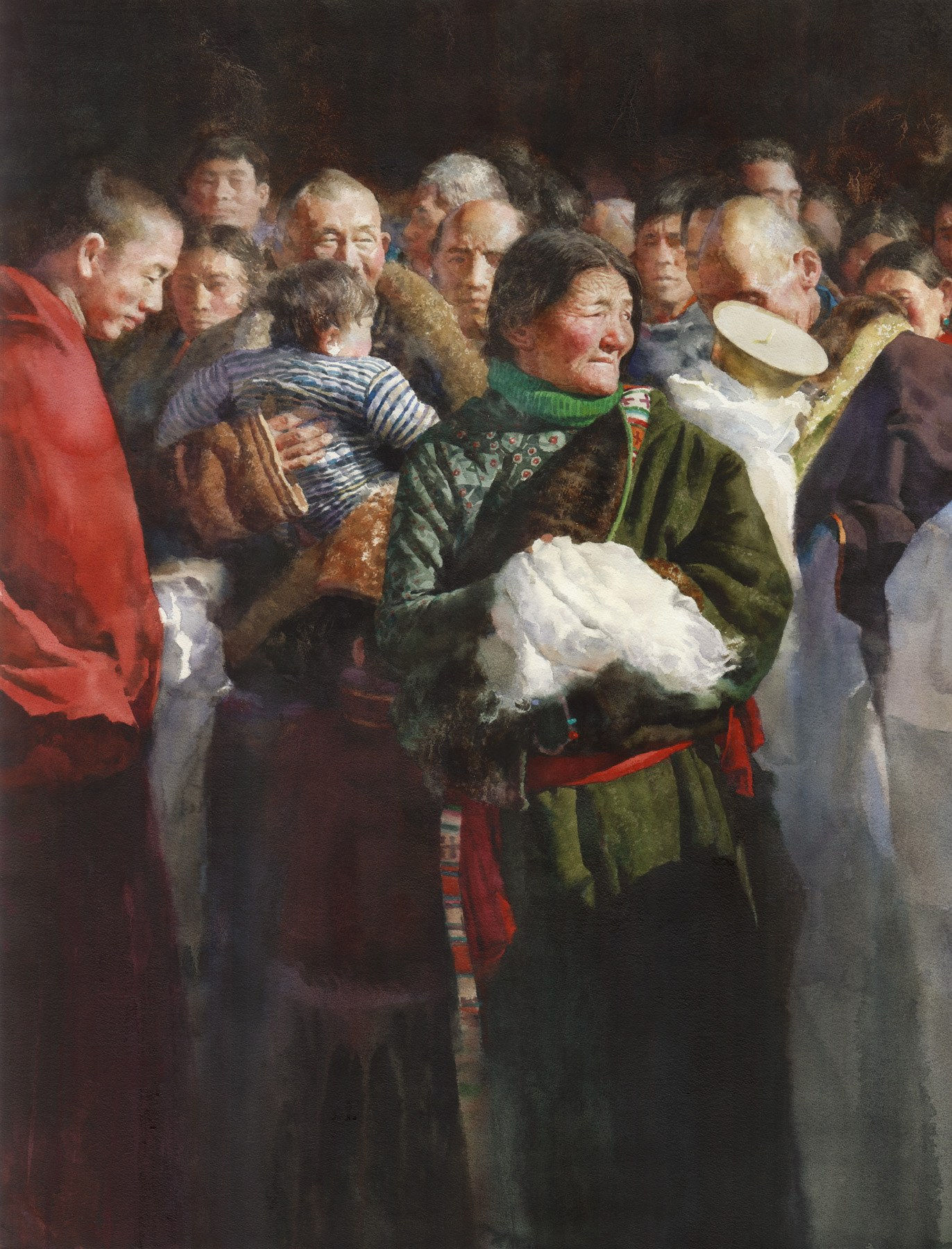
Tianya Zhou is a traditional watercolourist specialising in portraits and figures, with much of his work focusing on Tibetan people and culture. He is concerned by the tension between economic development and the preservation of the environment and traditional culture. As China undergoes rapid modernisation through construction and development, he sees the ecological environment and native cultures being threatened. Through his paintings, he seeks to record aspects of traditional Tibetan culture that are disappearing.
Zhou works primarily in pure watercolour, building paintings through many thin glazes of transparent paint, sometimes applying as many as 20 layers to create colour and depth. He sketches on site when travelling, developing ideas and compositions from direct observation, while also using photographs as studio references. His work combines wet-in-wet, dry-on-dry, wet-on-dry, glazing and washing techniques. He is particularly concerned with ideas, modelling, light and shadow, colour and composition, as well as balancing looseness with control and detail with roughness. He seeks to demonstrate the scale and complexity that watercolour can achieve while retaining the medium’s distinctive qualities.