

Our History
Early Years
The beginnings of the RI can be traced back to 1807 with the formation of the New Society of Painters in Water Colours. The New Society was inaugurated as an alternative to an existing society (now the RWS) which had been founded in 1804 and which exhibited only the work of its own members. From the start the New Society showed the work of non-members’ alongside that of members, a policy still followed today. Both societies were started at a time when watercolour was used for serious artistic expression. In the early years many highly regarded painters including Cotman, Turner, Cox, de Wint, Bonington and many others exploited the natural and luminous qualities of the medium to great acclaim.
The New Society changed its name in 1808 to the Associated Artists in Water Colours. The exhibitions attracted some of the foremost watercolourists of the time including: David Cox, Peter De Wint, William Blake, Samuel Prout, Paul Sandby and Joseph Powell. Even so financial problems caused them to fold in 1812.
New Society Of Painters In Watercolours
Nineteen years later, in 1831, Joseph Powell with several like minded artists resurrected the New Society of Painters in Water Colours. The next few years were stormy ones with considerable internal disputes and major changes in policy. In fact the society abandoned the policy of exhibiting together both non-members and member’s work thus losing a vital component of the difference between the Old and New Societies. Even so, and despite strong competition from both the Royal Academy and the Old Watercolour Society, the society thrived during these years and concentrated on consolidating its position as one of the foremost artist’s groups in the country.
The society’s growing strength during the period around the middle of the 19th Century shows it at the forefront of the movement to get more recognition for watercolour painting. The Royal Academy, who continued to dismiss watercolour painting as a serious art form, stood firmly at the centre of the British art establishment and in 1858 the government proposed a new gallery and building at Burlington House to house the RA and other art groups. The then President of the New Society, Henry Warren, proposed that the Old and New societies should group together and pose a united front to gain a place in the new building. Unfortunately the move failed but the New Society continued to fight for watercolour’s rightful place as a serious medium for art.
Institute Of Painters In Watercolours
In 1863 the New Society became the Institute of Painters in Water Colours. Two years later a new group of watercolour painters was inaugurated, they showed their work at The Dudley Gallery in the Egyptian Hall in Piccadilly and soon became know simply as the Dudley. Their exhibitions were open to all-comers thereby filling the vacuum left when the New Society closed their doors to outsiders and this policy attracted some of the best emerging artists of the day. Some of these artists began to join the Institute. In 1883 the Institute moved into their new gallery in Piccadilly opposite Burlington House.
Royal Institute Of Painters In Watercolours
In the same year the Institute and the Dudley joined forces and in 1885, by command of Queen Victoria, the Institute was able to add the prefix ‘Royal’ to its title.
The amalgamation of the Dudley and the Institute and the move to the new premises in Piccadilly coincided with a major change in the (soon to become Royal) Institute of Painters in Water Colours exhibition policy. After many years of exhibitions limited to the work of members only, the RI reopened their doors to all comers.


16 Old Bond Street
Gallery of New Society of Painters in Watercolours, 1834
George Scharf (1788-1860)The first three exhibitions of the second-flowering of the New Society, 1832-1834, were held at 16 Old Bond Street, London; the painting (above) by George Scharf is a view of this gallery, painted to record one of these inaugural exhibitions (it is dated 1834).

Exeter Hall
Exeter Hall, The Strand, London (circa 1837)
The next three exhibitions were held at Exeter Hall in The Strand (where the Strand Palace Hotel now stands). After 1838 the society established itself at 53 Pall Mall, next door to the British Institution at number 52, where it remained until 1883.

190-195 Piccadilly
Royal Institute of Painters in Water Colours Galleries, 190-195 Piccadilly, London W1
From 1883 until 1970 the RI was housed in a magnificent building in Piccadilly, almost opposite the Royal Academy. Designed by E R Robson the galleries opened with an exhibition of nearly 900 pictures, and a brilliant ceremony attended by the Prince of Wales.
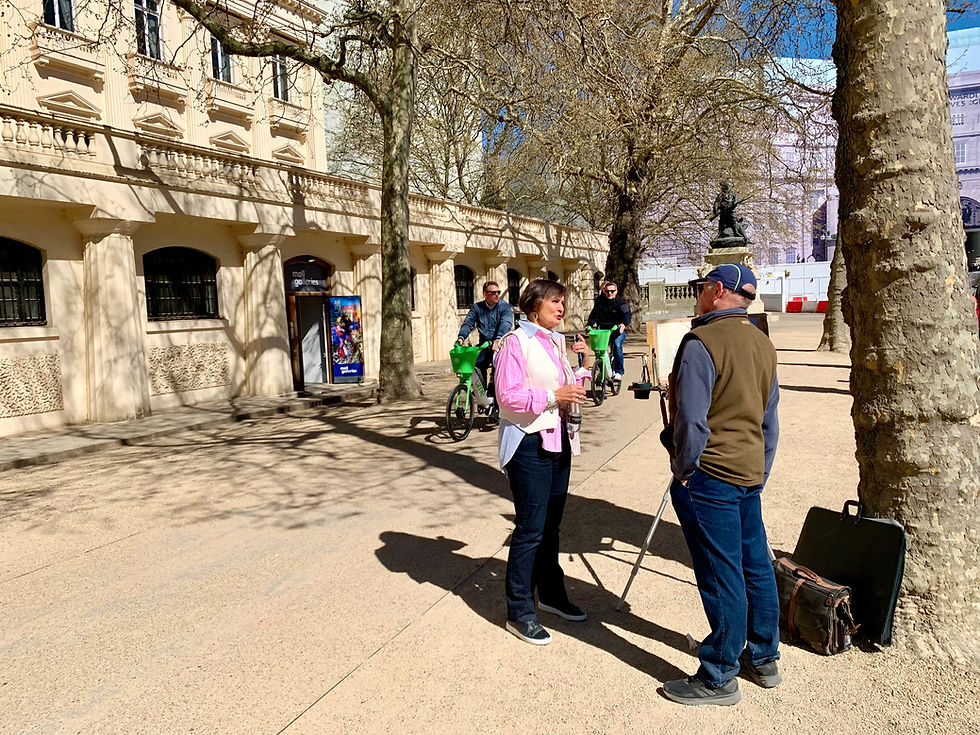
The Mall Galleries
The Mall Galleries, The Mall, London SW1 UK
The RI remained in Piccadilly until the lease expired in 1970, then joined with several other leading art societies in the Federation of British Artists based at the Mall Galleries which were opened by Her Majesty the Queen in 1971. Its three galleries are situated in the basement of 17 Carlton House Terrace, at the east end of two terraces of white stucco-faced houses on the south side of the street overlooking St. James’s Park. These terraces were designed by John Nash and built as private dwellings in 1827-32. The gallery and offices are leased from the Crown Estate by the Federation of British Artists.
RI Presidents

Juliette Losq
2025-present
Chris Myers
2022-2025
Rosa Sepple
2017-2022
Andy Wood
2014-2016
Ronald Maddox
1989-2014
Charles Bone
1979-1989
Aubrey Sykes
1973-1979
Rowland Hilder OBE
1963-1973
Norman Wilkinson CBE
1936-1963
Terrick Williams RA
1933-1936
Sir David Murray RA
1916-1933
Sir James D Linton
1909-1916
Edward John Gregory RA
1898-1909
Sir James D Linton
1884-1898
Louis Haghe
1873-1884
Henry Warren
1838-1873
Thomas Maisey
1833-1838
Joseph Powell
1832-1833